Iran’s possible partition: is it worth it for Azerbaijanis?
by Murad Tahmazov
This article is the result of a collaboration between the Osservatorio N.A.M.A. and the CRESCENT Research Center, based in Baku, Azerbaijan.
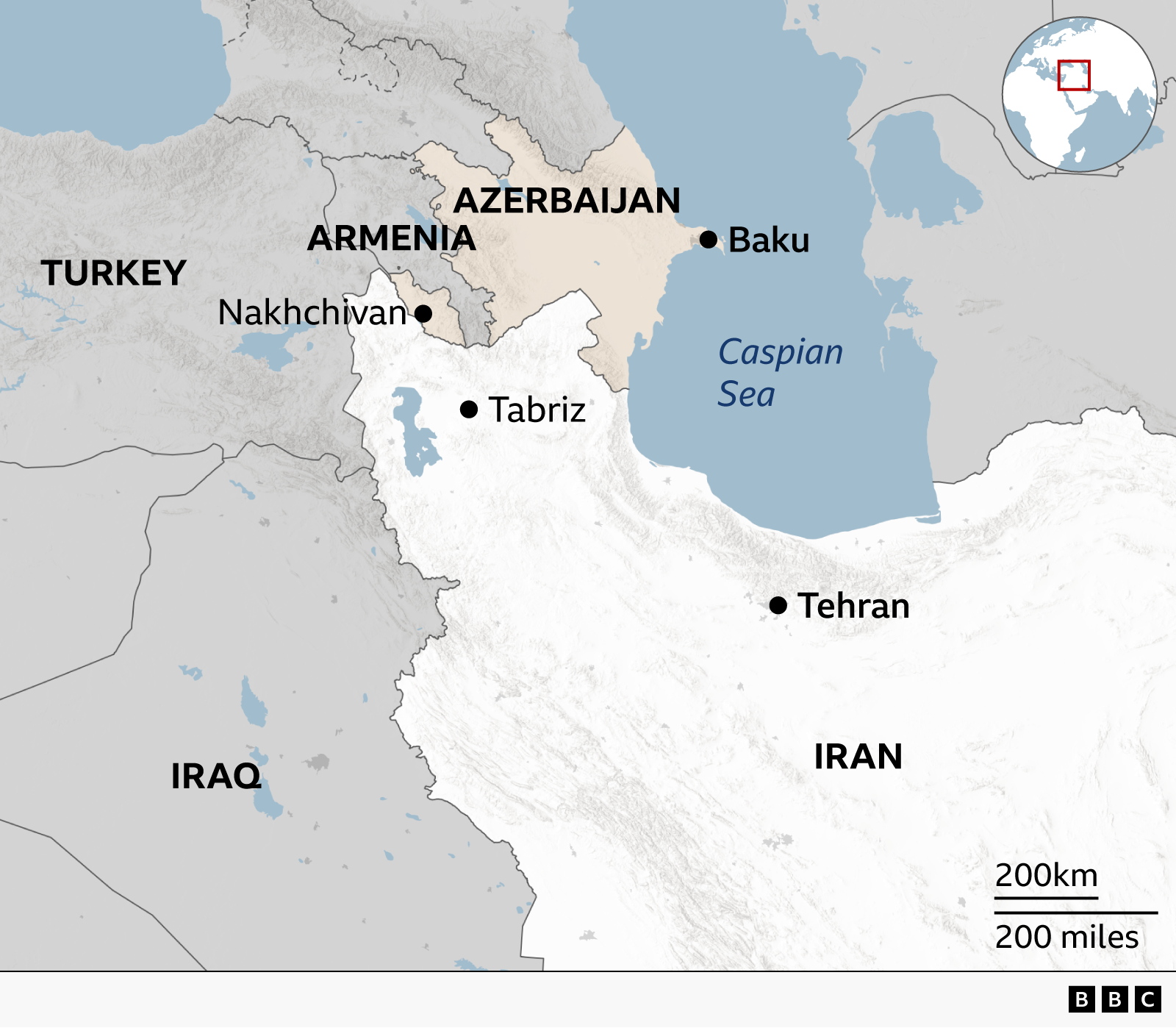
Source: BBC
On February 28, the Israeli government finally managed to achieve its decades-long aim of dragging the United States into a war with the Islamic Republic of Iran. A previous attempt during the 12-day war in 2025 did not bring the ultimate outcome—namely, a regime change or at least a shift in Tehran’s foreign policy—despite US involvement on the last day of operations. Although both Tel Aviv and Washington claimed success in curbing Iran’s nuclear weapons ambitions by bombing its main nuclear facilities in Fordow, Natanz, and Isfahan, this did not stop them from using the same excuse, among others, to attack Iran again—this time on a much greater scale and with greater intensity.
One noteworthy aspect of this war is the ambiguity of its intended outcome, or perhaps even the lack of one. Both sides have their own advantages. Israel and the United States possess a clear technological edge over Iran, which gives them the power of near-complete aerial superiority over Iranian territory, exposing a wide range of targets, from high-ranking officials to industrial facilities, to US and Israeli airstrikes. On the other hand, Iran’s drones and ballistic missiles are much cheaper and easier to produce than the interceptors needed to stop them. In the long run, unless the United States or several regional countries significantly increase their military-industrial production, effectively turning their economies into wartime economies, similar to what Russia is doing, those interceptors are likely to run out, potentially giving Iran the upper hand.
Under these circumstances, Israel, in particular, viewing the Islamic Republic as an existential threat, having its national security at stake, and facing the risk of growing discontent in US public opinion and among Gulf states, wants this military action to produce some kind of desirable outcome. These outcomes could range from a mere realignment of Iran’s foreign policy to the complete fragmentation of the country, all within a relatively short time frame. This may explain why Israeli and US officials avoid clearly stating the “endgame” of this war, preferring instead to keep multiple options open. In this article, I will briefly examine one particular partition scenario for Iran and what it could mean for Azerbaijanis, the country’s largest minority.
For years now, an ethnic map of Iran has circulated widely on the internet, often suggesting that Persians might actually be a minority and implicitly implying that this would make it easy to break up the country. In reality, not all minorities in Iran have problems with Iranian identity. If we classify minorities according to their level of dissatisfaction with both the Islamic Republic and the broader concept of Iranian identity, Baloch and Kurdish populations could be considered highly dissatisfied, Azerbaijanis and Ahwazi Arabs moderately dissatisfied, and others mostly not dissatisfied.
It is therefore not surprising to see Israel supporting Iranian Kurdish militant groups usually stationed in Iraqi Kurdistan, or US President Donald Trump recently holding a call with Iraqi Kurdish leaders. One key organization to keep in mind is PJAK, the Iranian branch of the PKK, of which Rojava’s PYD is also an organic part. PJAK receives most of its support from Kurmanji Kurds, who mostly reside in the northern and central parts of Iran’s West Azerbaijan province. This province has an Azerbaijani majority with a sizable Kurdish minority consisting of both Kurmanji and Sorani groups.
Since the Kurds are among the minorities most likely to receive military backing from the United States and Israel, West Azerbaijan could become a place d’armes for a Kurdish insurrection in Iran, marking the beginning of a ground warfare phase. This may explain the high concentration of aerial attacks in the province, especially those targeting border guards.
This raises an important question: how should, and how will, the Azerbaijani community react? To answer this, several factors must be considered. There has been a certain level of tension between Azerbaijanis and Kurds for decades, if not centuries. These tensions stem from religious differences (with Kurds being predominantly Sunni and Azerbaijanis predominantly Shia), differences in government treatment (Kurds face discrimination on both religious and linguistic grounds, whereas Azerbaijanis primarily face linguistic discrimination but are often favored in government appointments), and differing levels of militarization. Although reliable statistics are lacking, it is widely known that Kurds, due to living in mountainous areas often beyond the full reach of the state, are more likely to bear arms, while Azerbaijanis rarely do so.
Additionally, both sides possess strong sentiments of national pride and view these territories as their own homeland, making compromise difficult. This creates a conflict of interest over a finite resource, territory, where finding a middle ground may be impossible unless at least one side’s interests are significantly compromised.
As a result, Azerbaijanis are likely to resist the emergence of a strong Kurdish force gaining power, particularly if it could lead to the redrawing of ethnic borders. Considering that Azerbaijanis are more represented in government positions but less armed among the local population, such tensions could lead to bloodshed. What begins as a Kurdish struggle against the Iranian government could transform into an ethnic conflict between Kurds and Azerbaijanis, which in turn might drag Azerbaijan and Turkey into the conflict. This would not only turn the whole of Iranian Azerbaijan into a battleground but could also significantly widen the scope of the war.
It is difficult to imagine Azerbaijanis supporting a scenario that would bring further bloodshed and destruction to their homeland, potentially resulting in massacres followed by ethnic cleansing. Moreover, Tehran could attempt to mobilize Azerbaijanis against a possible Kurdish uprising, risking thousands of lives in a battle whose outcome would be highly uncertain.
In conclusion, the Azerbaijani community in Iran may find itself forced to swallow a poisonous pill—becoming cannon fodder in a war that is not being fought for their benefit. The largest minority in a country whose economy has been devastated by thousands of sanctions, and which is now being bombarded daily by the world’s most powerful military, alongside its highly militarized, warmongering ally, cannot reasonably be expected to sacrifice even more.
It might ultimately be best for all sides if Kurdish movements draw some decisive lessons from how the United States, once the biggest supporter of the Kurdish cause, abandoned the YPG, declaring that its role as an ally had “largely expired.” Expiry can indeed be a valid reason to refuse to be used again.